
How Bangladeshi Students Can Benefit from AI in 2027 — And How EduBido Is Shaping the Future of Learning
Discover how AI can help Bangladeshi students in 2027 with NCTB-based learning, SSC and HSC preparation, personalised practice, and EduBido's vision for smarter education.
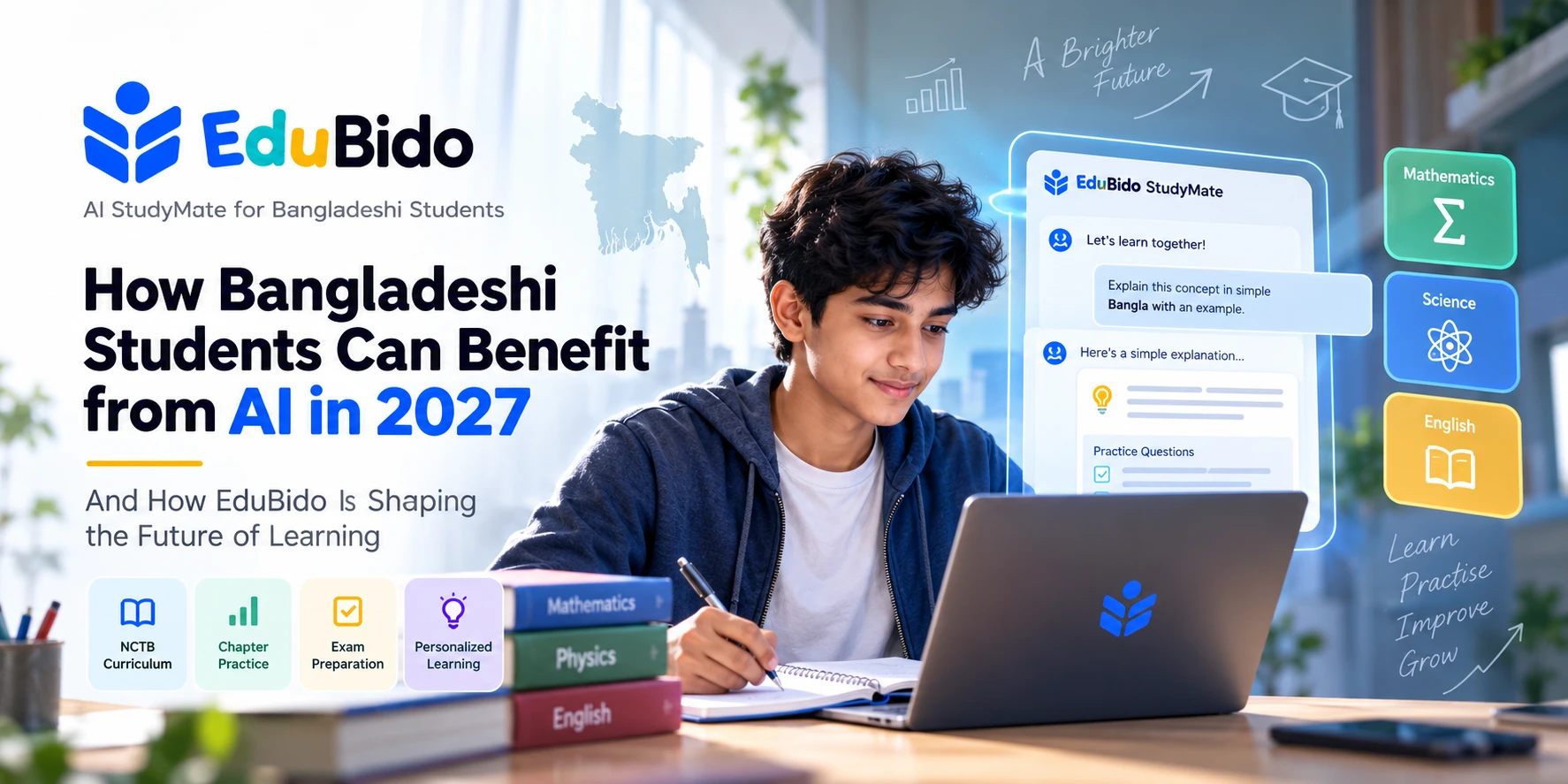
Artificial intelligence could transform how students in Bangladesh study, practise, and prepare for their future. With curriculum-focused learning, personalised explanations, and smarter practice, AI can help make education more accessible and effective.
Education is changing rapidly. Around the world, artificial intelligence is creating new ways to access information, practise skills, and understand difficult concepts. For students in Bangladesh, 2027 could be an important period in the development of AI-assisted learning.
Yet the real opportunity is not simply giving students another tool that can answer questions. It is helping them understand their textbooks, identify their weaknesses, practise more effectively, and develop the confidence to learn independently.
A student preparing for SSC, an HSC student struggling with physics, or a school student trying to understand a difficult mathematics chapter may all need different kinds of support. AI has the potential to provide more flexible assistance, provided it is accurate, affordable, and designed around students' actual learning needs.
This is the problem that interests me as an engineering student and the Founder & CEO of NexBido Labs Ltd. It is also the idea behind EduBido, an AI-powered educational platform being developed with Bangladeshi students and their curriculum in mind.
1. Personalised Learning for Every Student
One of the biggest challenges in education is that students do not learn at the same pace.
In a traditional classroom, a teacher must manage a schedule while supporting students with different levels of understanding. Some students grasp a concept quickly, while others need additional examples or a different explanation.
AI can help make learning more flexible.
Imagine a Class 8 student who cannot understand a mathematical formula. Instead of simply memorising it, the student could ask an AI learning assistant to explain the concept in simple Bangla, demonstrate a worked example, and provide a few practice questions.
If the explanation is unclear, the student can ask follow-up questions and explore another approach.
The goal is not to replace the classroom teacher. It is to give students additional opportunities to understand what they are learning.
How EduBido fits into this vision
EduBido is being developed to support curriculum-focused learning for students in Bangladesh. Its vision is to bring learning assistance, chapter-based practice, and AI-supported explanations into a more connected experience.
Through the planned EduBido StudyMate experience, students could receive help understanding difficult concepts and practise topics related to their studies.
The principle is simple: learning support should respond to the student's needs, not just deliver the same explanation to everyone.
2. Making the NCTB Curriculum More Accessible
For Bangladeshi school students, following the National Curriculum and Textbook Board (NCTB) curriculum is an important part of their education.
General-purpose AI tools can answer many questions, but they may not always follow the exact textbook, chapter structure, terminology, or expected learning outcomes used in Bangladesh.
This creates an opportunity for educational technology designed specifically for the local context.
A curriculum-focused learning platform could help students:
- Understand difficult textbook concepts through simpler explanations.
- Practise questions related to specific chapters.
- Review important definitions, formulas, and ideas.
- Test their understanding after completing a lesson.
- Identify topics that require further revision.
EduBido is being developed around this kind of educational experience. The aim is to connect AI assistance with the learning materials and curriculum that Bangladeshi students actually use.
Accuracy must remain a priority. Educational content should be checked against appropriate textbooks and curriculum requirements, and AI-generated questions should not be presented as guaranteed exam questions.
3. Smarter Preparation for SSC and HSC
SSC and HSC examinations are important milestones for many students in Bangladesh. Preparing for them requires more than spending long hours with textbooks. Students also need to understand concepts, practise questions, review mistakes, and manage their time.
AI can help students organise this process.
A student could complete a chapter, attempt a short practice test, review incorrect answers, and then focus on the concepts that need improvement.
A practical study cycle might look like this:
- Assess: Take a short quiz to understand what you already know.
- Identify: Find the concepts and question types that cause difficulty.
- Practise: Solve additional questions focused on those areas.
- Review: Understand why mistakes happened.
- Retest: Attempt new questions to check whether understanding has improved.
EduBido aims to support this kind of chapter-focused practice and learning assistance.
Rather than encouraging students to memorise predicted questions, the goal should be to help them understand the curriculum and become more confident in applying what they learn.
AI cannot guarantee examination results. Those depend on the student's preparation, understanding, effort, and performance on the day of the exam.
4. Learning Beyond Memorisation
Memorisation has a place in education, but it is not enough on its own.
A student may remember a formula but struggle to apply it to an unfamiliar problem. Another student may memorise a scientific definition without fully understanding the concept behind it.
AI can offer alternative explanations, practical examples, and follow-up exercises to help students explore the meaning behind information.
For example, a student studying physics could ask what a formula represents, what each symbol means, and how the formula applies to a real-world situation. The student could then solve practice problems independently.
This approach encourages active learning rather than passive reading.
EduBido's broader vision is to make curriculum-based learning more interactive, so that students have more opportunities to ask questions, practise concepts, and understand their mistakes.
The real measure of progress should not be how quickly a student receives an answer, but how well that student can explain and apply the concept independently.
5. Supporting Students Who Have Limited Access to Extra Help
Not every student in Bangladesh has equal access to private tutoring, additional learning materials, or individual academic support.
Some students have access to multiple educational resources, while others depend mainly on classroom lessons and textbooks.
AI could provide additional learning support outside school hours. A student who does not understand a topic during class could revisit it later, ask for another explanation, and practise similar questions.
However, technology alone cannot eliminate educational inequality.
Internet access, device affordability, electricity, digital literacy, Bangla-language quality, and the cost of AI services all affect whether students can benefit.
For AI-assisted education to have a meaningful impact in Bangladesh, tools must be practical and accessible to students with different backgrounds and resources.
This is an important consideration when developing EduBido. A useful educational platform must be designed around the realities of its intended learners, not only the capabilities of the technology.
6. Improving English and Digital Skills
The benefits of AI extend beyond school examinations.
Students can use AI tools to practise English writing, improve vocabulary, understand unfamiliar words, and prepare for interviews. They can also explore programming, data analysis, research, and other digital skills.
For example, a student could ask an AI assistant to explain a programming error, review a paragraph for grammar mistakes, or suggest exercises for learning a new concept.
But AI should be treated as a learning partner rather than a substitute for practice.
Students still need to write their own sentences, solve their own problems, build projects, and evaluate the information they receive.
As technology changes the workplace, independent thinking, communication, problem-solving, and responsible digital skills will remain important.
7. The Role of Teachers in an AI-Assisted Future
AI in education should not be understood as a replacement for teachers.
Teachers provide guidance, motivation, context, and human understanding. They can recognise when a student is discouraged, help resolve misunderstandings, and encourage intellectual curiosity in ways that automated systems may not fully replicate.
AI may help teachers prepare practice materials, develop alternative explanations, and review patterns in student performance. This could create more opportunities for meaningful interaction between teachers and students.
The strongest approach is to combine intelligent tools with human guidance.
EduBido's vision is not to remove teachers from the learning process. It is to help students access additional learning support and practise more effectively beyond the classroom.
8. Why AI Must Be Used Responsibly
AI tools can make mistakes. They may produce inaccurate explanations, misunderstand questions, or provide information that does not match a student's curriculum.
Students should verify important information against textbooks, teachers, and reliable sources.
They should also avoid copying AI-generated answers without understanding them. Completing an assignment quickly does not necessarily mean that learning has taken place.
A responsible approach includes:
- Attempting questions independently before checking answers.
- Asking for hints and explanations rather than always requesting complete solutions.
- Verifying facts, formulas, and calculations.
- Following school rules on AI use and academic integrity.
- Protecting personal information and account credentials.
The purpose of educational AI should be to strengthen independent learning, not create dependence on automated answers.
9. EduBido: Building an AI Learning Companion for Bangladesh
The idea behind EduBido comes from a practical question: how can AI become genuinely useful in the everyday learning journey of a Bangladeshi student?
A general-purpose AI assistant can answer many questions, but students need more than isolated answers. They need a learning experience connected to their curriculum, chapters, practice activities, and areas for improvement.
EduBido is being developed as an AI-powered educational platform focused on the needs of Bangladeshi learners and the NCTB curriculum.
Its vision includes bringing together several aspects of learning:
EduBido StudyMate
The planned AI learning companion is intended to help students ask questions, explore difficult concepts, and receive explanations that support understanding.
Chapter-based practice
Curriculum-related MCQs and other practice activities can help students test their understanding and strengthen their knowledge.
Learning and revision support
Practice results can help guide students towards topics that may require further attention, while chapter-focused activities can make revision more structured.
A more connected learning experience
The broader goal is to bring learning support and practice into one educational environment rather than making students rely on disconnected tools for every task.
These capabilities must be developed, tested, and refined around students' real needs. The quality of the experience will depend on curriculum alignment, accurate educational content, reliable AI responses, and feedback from learners and teachers.
EduBido is not intended to replace schools or teachers. It is an effort to make additional learning support more accessible and help students become more confident, independent learners.
10. My Vision as a Founder
As an engineering student and the Founder & CEO of NexBido Labs Ltd., I am interested in building technology that addresses real problems.
For me, EduBido represents an opportunity to explore how AI can support education in a way that reflects the needs of Bangladeshi students.
Developing an educational platform requires more than integrating an AI model. It requires understanding the curriculum, designing a useful student experience, maintaining content quality, protecting users, and listening to feedback from the people who will use the product.
The vision is to develop an educational companion that helps students understand difficult concepts, practise what they learn, and recognise where they need to improve.
I believe educational technology should be judged not simply by how advanced it appears, but by whether it genuinely helps learners.
EduBido's progress will ultimately be measured by how well it serves students, how responsibly it uses AI, and how effectively it supports meaningful learning.
Conclusion: The Future of Learning Should Empower Students
In 2027, AI could become an increasingly useful part of education in Bangladesh. It offers opportunities for personalised explanations, chapter-based practice, examination preparation, language learning, and digital skill development.
But technology alone cannot guarantee better education. Students still need effort, curiosity, teachers, reliable learning materials, and the ability to think independently.
EduBido is being developed around the belief that AI can play a constructive role when it is designed for the learner's actual needs and used responsibly.
The future should not be about students depending on AI to think for them. It should be about giving students better tools to understand, question, practise, and learn.
My vision for EduBido is simple: to help make learning more personal, accessible, and effective for Bangladeshi students—so that AI becomes a companion in their learning journey, not a replacement for their own thinking.